DTF: Could the Stakes be Higher?
December 09, 2025
Stakes MFG is one of the largest print-on-demand companies in the United States with a 110,000 square feet digital production facility and state-of-the-art technology delivering the highest quality DTF and DTG printing for apparel, hats, and bags. We caught up with Stakes MFG’s Senior VP of Operations Shawn King to find out how the team evolved their cutting-edge facility, and what difference partnering with Caldera has made to the workflow.
With a fleet of Kornit Max printers for DTG, and a fleet of proprietary, best-in-class equipment for DTF, Stakes MFG has earned the trust of many of the world’s leading sports, entertainment, retail, e-commerce, customization, printing, and promotional product companies.
Stakes helps partners increase revenues, generate margin improvements, and expand product offering while decreasing inventory costs and risk. Stakes MFG’s white label solution supports both direct to consumer, e-commerce individual order fulfillment as well as quick turn, wholesale fulfillment with no minimums.
Offering tailored Enterprise Print on Demand solutions, their mission is to meet the needs of each individual partner rather than selling a one-size-fits-all service.
We are passionate about our people, partners, and printing. Our people and culture are the driving forces in building and cultivating strategic partnerships. We ship millions of units annually out of our Cleveland facility. We utilize a hybrid of best-in-class DTG and DTF equipment and production processes that meet the highest quality and sustainability standards in order to offer our partners an extensive catalog of cotton, polyester, and blended apparel, headwear, and bags.
We utilize our proprietary file prep process to provide unmatched levels of color accuracy and consistency. We create a lot of in-house technology and modify equipment, working with a lot of OEMs to create our ideal automated workflow and drive innovation.
– Shawn King
Being able to deliver industry leading fast turnaround times and retail quality prints is important to Stakes MFG, and they offer more than 90,000 SKUs including premium brands. “It means that our value proposition is offering a very large catalogue, with speed, tailored solutions, while priding ourselves on the quality and consistency of what we produce as an extension of our partners brands.”
DTF – The Early Days
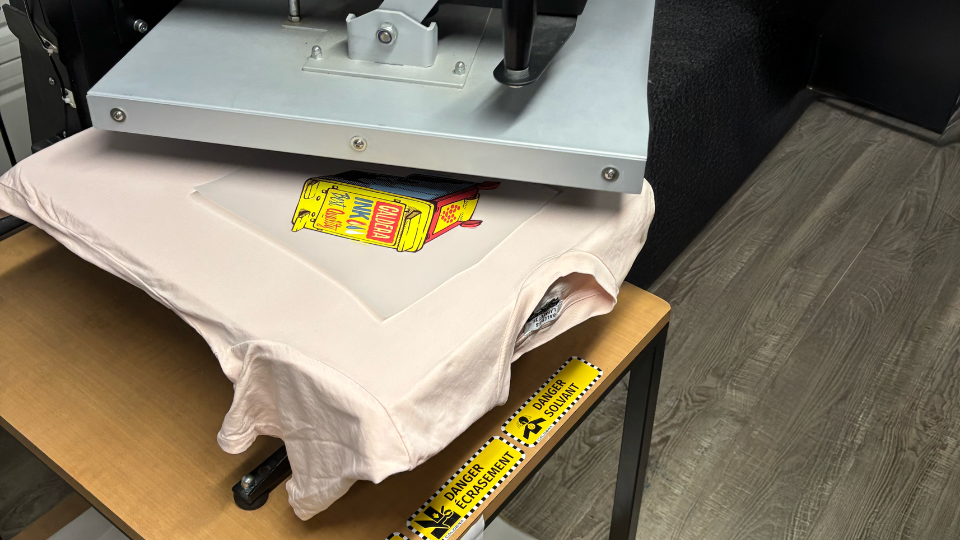
We were early adopters of DTF printing at a large scale and at that time, there weren’t any RIP solutions that could support our partner’s and their client’s high-quality expectations.
All the machines were very similar, and still are – they look the same and operate the same. People are introducing innovations now, but in those infancy stages, the RIPs didn’t really offer support in terms of color management , including spot color replacement and underbase separation and generation.
They didn’t handle the transparencies well, and that’s always been a challenge with DTF. Back then, it was basically a RIP that could just ingest a file and give you some output that wasn’t really the desired output – and you had no control over it.
– Shawn King
This situation was the catalyst that started Stakes on their search for a RIP that worked and better technology. “We didn’t have a good digital system for polyester at that time.
Our partners wanted us to have a larger polyester offering for performance wear and business attire such as golf shirts, quarter zips, outerwear as well as expand into headwear and bags. So, we bought our first system and the demand for the technology took off.
Once word got out about our elevated DTF quality and we were scaling quickly to meet demand, interestingly we started to also have businesses approach us to be their transfer only supplier for individual transfers, sheets, and rolls, when previously everything we did was full package printed apparel. It didn’t take long for one machine to grow into a fleet and DTF to become a significant percentage of our business.”
The Challenges of Innovation
When it comes to the implementation of a new technology, there are always going to be hurdles to overcome.
“The workflow was challenging at first,” explains Shawn, “because now you’re trying to manage the printing from upstream, and then figure out how it’s all going to come together to decorate individual units and then ship them, without adding a ton of expensive labor to it.
While DTF equipment is exponentially less expensive than DTG, the labor needed is exponentially higher because there’s printing, cutting, QC transfer, matching transfer to substrate, pressing transfer, and QC of final product.
Labor costs have continued to rise significantly year of year which is why we needed focus on streamlining processes and automating wherever possible.”
The desire for automation meant that the systems Stakes MFG developed in-house needed to integrate seamlessly into the workflow. “Of course there were some speed bumps with the workflow,” says Shawn. “It was a definitely a challenge to introduce on demand color management and testing consumables that were all over the place in the infancy stages.
The film and ink was inconsistent, equipment had downtime issues and needed hardware improvements, and there were problems with print color vibrancy and accuracy. We’d moved into a DTF space where we had six colors – CMYK, plus red and green – but we had to take a step back because none of the DTF printers at the time had any sort of gamut extenders. We were locked into CMYK, which was tricky.
We had to figure out how to profile these machines ourselves and sourced our own proprietary consumables. We knew we weren’t going to exactly replicate the hand-feel of DTG, but quality in terms of both color accuracy and hand feel of the majority of DTF transfers in the market still today, wouldn’t suffice for our enterprise partners. We had to do a lot of tedious R&D and engineering to make a better product.”
A Growing Partnership with Caldera
The need for upstream software that could address these different issues was acute. The first problem Caldera tackled was moving nested files and cut files through the API to the printers over the network.
Shawn explains: “We started using the Caldera nesting software pretty early on, and we were able to get those files quickly over to our in-house cutters – and that was a big win, because when we started, we didn’t have that ability.
Hotfolder management and network management were the first things addressed.
Then we started having conversations with the Caldera team about color management. They were really invested in working with us, as it was a market they were just starting out in. Our partnership continued to grow to address the other DTF challenges, and Caldera really had the knowledge and the appetite to quickly deliver any modifications or updates that we needed.
For example, one issue we had with our cutter was the QR codes were too close to the image. Caldera made an update that rolled out quickly to give us more space.
Caldera’s agility to move quickly was just what Stakes MFG needed, but even bigger was the difference the software made to color management.
“Being able to feed a DTF file through using either our custom color libraries or some sort of spot replacement was a game changer. Our partners often use custom color libraries, so it’s really good to be able to just drop a spectro on a color and then scan it in for quick and seamless color management.”
It was actually a different brand DTG printer that Stakes was testing and no longer uses that led Stakes MFG to approach Caldera.
We were testing other DTG equipment but determine Kornit was the best solution for us and our partners and Caldera had software for the other equipment for the creation and manipulation of the color and underbase, as well as for their jetting adhesive.
We realized that if we could use that ability in the DTF world, we’d be able to better hit our quality goals. So, we reached out to Caldera.
They still had the technology, though it wasn’t implemented anywhere, and when we suggested bringing it into DTF, they were immediately onboard with it.
That was the jumping off point for a partnership that has really pushed the boundaries in evolving DTF printing. “The Caldera team was fantastic. We were getting very fast implementations and updates for our R&D process and custom needs, and this joint effort continues to this day.”
DTF: The Evolution Continues
As early adopters, Stakes MFG has seen every iteration of digital DTF printing so far, and they continue to be at the cutting edge of its development. “I think automation is really what everyone’s looking for now in the DTF space, and a lot of people are working towards it.
You see it every year – a new heat press carousel or a larger faster machine comes out. Speed is key, and inline automation can bring it.
We’re all trying to reduce as many touch points as we can in the workflow to decrease costly labor. We are always iterating and engineering new improved processes and technology supports to every step of the DTF process.”

“New drastically improved DTG technology and chemistry in combination with our proprietary file prep process allows Stakes to produce digital prints that are indiscernible from screen printing in print quality, hand feel, and durability. We are working hard to help DTF catch up with improvements in automation and hand feel but there is more for innovation and improvement.”
Partnerships like Stakes MFG and Caldera’s is what pushes the digital printing industry forward. As Shawn puts it:
Collaboration with Caldera has been great. Some partners place limitations on what can be achieved, but Caldera is the complete opposite. Whatever we need, their team bends over backward to develop, and constantly asks us what new features would help.
Caldera is an expert at what they do, so they make a great sounding board for our DTF production and software ideas and needs.
It’s a symbiotic relationship that works for both companies, and we get great support and interaction, which is more important than simply measuring the relationship at a software level. Caldera continues to help us scale and streamline our business to meet and exceed our partners high quality expectations, which we deeply appreciate.
All we can say here at Caldera is the feeling’s mutual, nothing can beat a great collaboration.
Curious about Caldera DTF and DTG Solutions?
Learn more about Caldera Direct-to-Film and Caldera Direct-to-Garment software.
Related articles