Today’s Graphics, Inc. (TGI) Group Eliminates Hours of Manual Imposition with PrimeCenter
October 05, 2026
Today’s Graphics, Inc. (TGI) is a specialty printing and marketing services company with 50 years of industry experience. What began as a type setting business has evolved into a multidimensional production partner offering digital printing, wide-format graphics, direct-to-object printing, B2B Marketing Portals and logistics.
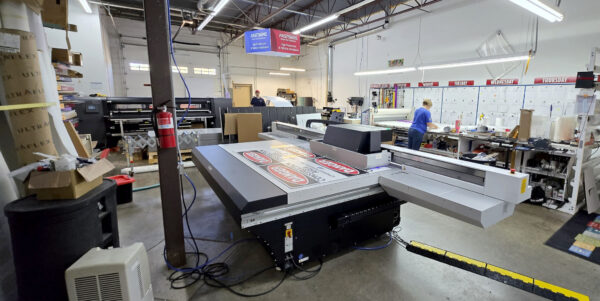
Based in the United States, TGI employs approximately 50 during non-peak and 200 during peak and serves a broad business-to-business-to-consumer customer base. Around 80% of its current business involves wholesale printing for companies such as Canva, Shutterfly, and other well-known online print brands. Its production capabilities include:
- 3-HP Indigo B2 Digital presses
- Two HP Latex R2000 printers
- A DigiTech TruFire LT/X2
- Kongsberg flatbed cutters
- Latex roll-to-roll printers
- Direct-to-object printing equipment
TGI produces banners, signs, posters, yard signs, printed objects, and other specialty applications.
The challenge: Manual imposition could not keep pace with growing volume
TGI’s wide-format team was preparing an increasing number of yard-sign orders in different sizes, quantities, orientations, and configurations. Some jobs were single-sided, while others were double-sided. Certain orders also required the corrugation flutes to run horizontally, while others required a vertical orientation.
Before PrimeCenter, the team manually imposed 4-by-8 sheets in Adobe InDesign. Although the process was familiar, it was increasingly time-consuming and difficult to scale.
When TGI was informed that its order volume would increase, the team recognized that it needed a more efficient production workflow.
We were manually imposing 4-by-8 sheets in Adobe InDesign. When we learned that our volumes would be ramping up, we knew we had to get PrimeCenter right away.
– Dan Long – Wide Format Product Manager
The solution: Recipes for repeatable production
TGI introduced PrimeCenter to automate and standardize the preparation of its wide-format jobs. The team created recipes for its recurring yard-sign workflows, including the required imposition, orientation, and single- or double-sided setup. Rather than building each layout manually, operators can select the appropriate recipe and apply the predefined production settings. This allows TGI to process a wide range of incoming orders while maintainingconsistency across the output.
PrimeCenter currently feeds TGI’s Caldera workflow. The company also uses hot folders as part of a broader semi-automated production environment. Files move through the workflow from the company’s existing automation tools into the relevant hot folders, where they are prepared for production.
“We leveraged the recipes that Joey Phillips and Sam Rummel helped us build against the orders coming in, and we got perfectly imposed sheets every time.”
– Dan Long – Wide Format Product Manager
The results: Hours of manual work reduced to a few clicks
PrimeCenter has removed much of the manual imposition work from TGI’s production process. Tasks that previously required hours in InDesign can now be completed in a few clicks using predefined recipes.
Key benefits
- Significantly less manual imposition
- Faster preparation of high-volume orders
- Consistent layouts across varying sizes and quantities
- Support for different board orientations
- Efficient handling of single- and double-sided jobs
- Repeatable workflows for recurring applications
- Better prepared for future volume increases
“The manual work is gone. There are a couple of clicks compared with what we were doing before, which was spending hours in InDesign.” – Dan Long – Wide Format Product Manager
Supporting a complex B2B2C production model
TGI’s wholesale customers generate a steady flow of orders with different specifications.
The company must accommodate a variety of sizes, orientations, quantities, and finishing requirements without creating bottlenecks in production.
PrimeCenter gives the team a standardized way to manage this variability. Recipes help transform diverse customer orders into consistent, production-ready files, while the company’s broader automation strategy provides a foundation for further workflow improvements.
TGI currently describes its workflow as semi-automated, using hot folders and manual load balancing between systems. The team is evaluating additional automation capabilities, including more advanced filtering, file organization, and API-driven processes.
A foundation for further automation
TGI began using CalderaRIP approximately 12 years ago after previously working with another RIP solution. The company selected Caldera because it saw a stronger focus on automation and future workflow development. PrimeCenter is now an important part of that strategy. While the team currently uses it primarily for imposition, TGI plans to explore additional capabilities, including:
- Organizing jobs by customer or file-name information
- Reducing the maintenance associated with numerous hot folders
- Extracting production details such as media names and copy counts
- Expanding automation through API-based workflows
- Exploring workflows that connect wide-format preparation with digital press production
“We’re slowly trying to streamline our workflow, and Caldera is a big part of it.”
– Dan Long – Wide Format Product Manager
The OutCome
By replacing manual InDesign imposition with recipe-based workflows in PrimeCenter, TGI has made its wide-format production process faster, more consistent, and easier to scale.
The solution has helped the company respond to increasing order volumes while managing the complexity of B2B2C production. With the manual work substantially reduced and further automation opportunities ahead, TGI has established a stronger foundation for efficient, repeatable print production.
| Challenge | Solution | Outcome |
| Hours spent manually imposing 4-by-8 sheets | PrimeCenter imposition recipes | Preparation reduced to a few clicks |
| Orders with varying sizes and quantities | Standardized production workflows | More consistent output |
| Single- and double-sided jobs | Application-specific recipes | Repeatable handling of different configurations |
| Different board orientations | Recipe-based orientation settings | Correct layouts for each requirement |
| Rising wholesale order volumes | PrimeCenter integrated with hot folders | A more scalable semi-automated workflow |
Customer statements have been edited for clarity and brevity. Results are based on the customer’s reported experience and may vary depending on workflow, equipment, and production volume.
Related articles