How CalderaRIP Makes Color Management and Production More Efficient?
September 08, 2026
You alrady know how hard it is to achieve accurate colors and how this process is essential in large format printing. To get there, you need to go through an endless testing campaign. To calibrate a color is to face the most demanding stages of large format printing workflow.
Operators need to find the right ink limits, balance light and dark inks, fine-tune color response, and make sure the final result remains consistent every time they print. And every adjustment you do can mean another test chart, another sheet of media, and another stretch of valuable production time.
CalderaRIP v19.3 operates differently. By introducing automatic Ink Limit recommendations, new ink-saving transition presets, and the Idealliance PrintWide2020 CMYK profile, the latest release makes color management more efficient while helping you maintain the quality and consistency that your customers expect. You will experience a simplified path from calibration to production. This means that you will have less testing, lower material consumption, and a stronger confidence in the final steps.
Faster and Easier Color Calibration
You always try harder to get the ink limit right because it’s fundamental to have a reliable color management workflow.
The ink limit setting determines how much ink can be applied while maintaining an effective balance between strength, print quality, drying behavior, and ink consumption.
And for you to find that balance traditionally involves printing test charts, examining the results, adjusting the settings, and repeating the process until you reach the desired result.
And if operators are used to manage several printers or media configurations, this will definitely be a time-consuming task.
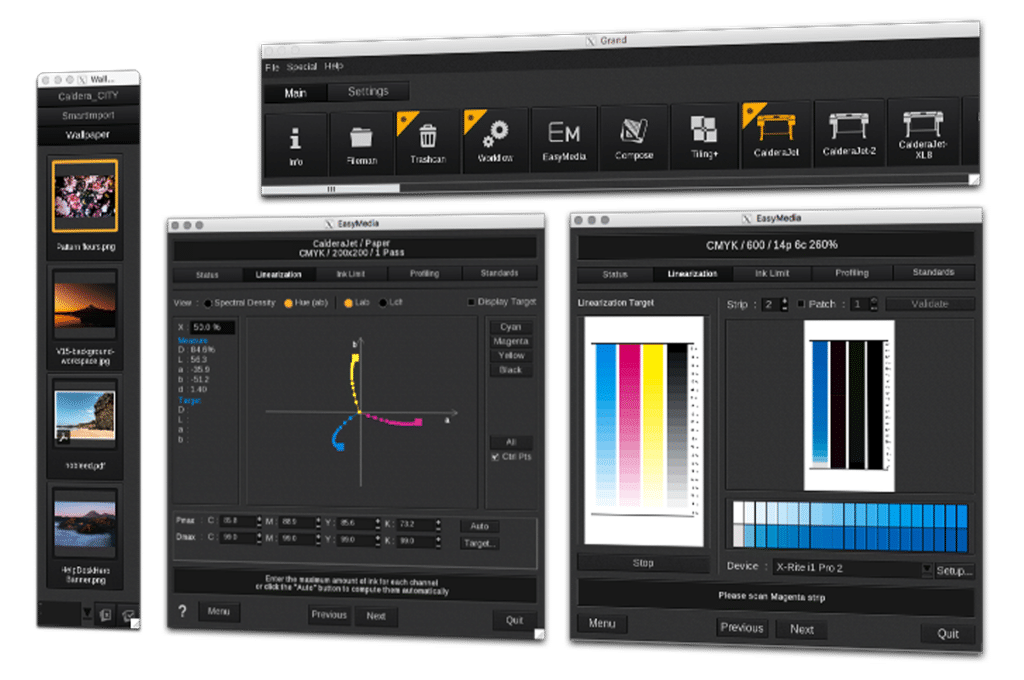
CalderaRIP v19.3 simplifies the process with a new automatic Ink Limit recommendation generated after spectral linearization.
Rather than beginning the ink-limit stage entirely through manual trial and error, the system uses the information gathered during the calibration process to provide a recommended value. This gives operators a more informed starting point and can reduce the number of physical tests required before reaching a production-ready setting. In this way, you spend less time waiting for test prints to see whether they are positive or not.
What if your calibration data can be turned into practical results?
This is where you can better visualize the real advantage of automation. It has the ability to make better use of information that has already been collected.
Spectral linearization provides valuable insight into how the printer and ink behave. With CalderaRIP v19.3, that information can contribute directly to the next stage of the workflow.
You can stop asking “which setting you should try”, you are now able to start from a data driven recommendation and focus more on validation and refinement.
Instead of repeatedly asking, “Which setting should we try next?”, operators can start from a data-driven recommendation and focus their attention on validation and refinement. For production teams, calibration stops feeling like experimentation and more like a guided process. And when a printer can reach a stable configuration sooner, production can begin sooner too.
Saving Ink without Compromising Quality
Every test print has a cost. There is the ink deposited on the page, the media used for the chart, the machine time required to produce it, and the operator’s time spent evaluating the result. When calibration is repeated across multiple printers and substrates, these costs become even more significant. This is why efficient ink management matters.
CalderaRIP v19.3 is designed to help reduce unnecessary ink usage during the calibration workflow. By making the Ink Limit process more efficient and improving the way ink is managed during linearization, the RIP can help operators avoid using more ink than necessary to achieve the required color performance.
The objective is not to simply reduce ink at all costs. It is to use ink where it contributes to the final image, and avoid unnecessary consumption where additional ink brings little practical benefit.
For print providers, this approach can translate into lower operating costs and a more efficient production process.

Simpler Ink Optimization for Light Inks
Light inks can make a remarkable difference to printed images. They help produce smoother gradients, softer transitions, and more detailed highlights, particularly in photographic and high-quality graphic applications. But their advantages also introduce another layer of complexity into color calibration. The relationship between light and dark inks needs to be carefully controlled.
If dark ink enters the tonal range too early, smooth transitions can suffer. If light ink remains active for too long, consumption can increase without delivering a meaningful improvement in the finished print.
Finding the right balance traditionally requires manual adjustments and repeated testing.
CalderaRIP V19.3 makes this process easier with new ink-saving transition presets.
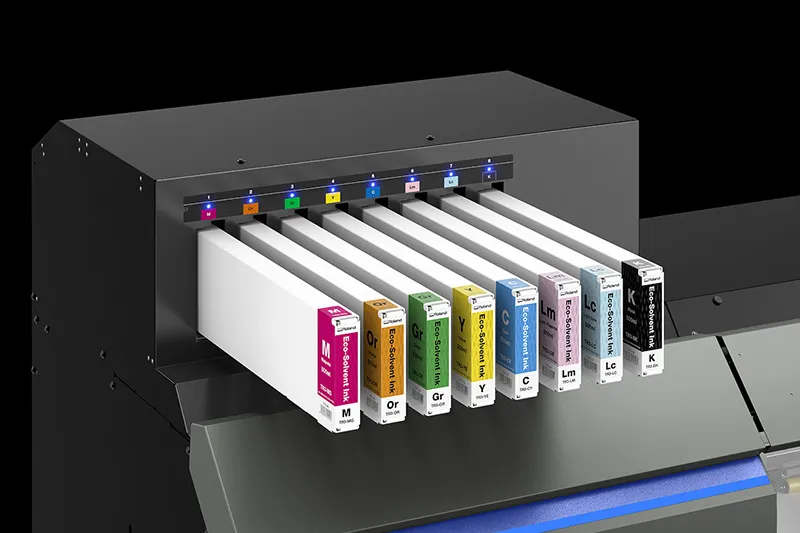
These predefined options provide operators with practical starting points for configuring light-ink behavior, reducing the amount of manual experimentation needed during setup.
Instead of building every transition from the ground up, operators can select an appropriate preset and fine-tune it when the specific production environment requires additional control.
A better balance between smoothness and efficiency
Ink optimization is not simply about minimizing consumption. The real goal is to find the point where print quality and resource efficiency work together. Well-managed transitions can preserve smooth tonal reproduction while reducing unnecessary use of light inks. This is particularly valuable for production environments where large volumes of work are printed repeatedly.
The benefits can be seen in both the workflow and the bottom line:
- Less time spent adjusting light-ink settings
- Fewer calibration tests
- More efficient ink consumption
- Consistent tonal quality
- Lower setup costs
- A simpler calibration experience for operators
The technology does not take control away from experienced users. Instead, it gives them a more efficient starting point.
More Consistent Color Across Printers and Print Runs
Speed and efficiency are important, but consistency remains at the heart of professional color management. A print job may look perfect on one device and still produce different results when reproduced on another. Changes in printers, substrates, inksets, or production conditions can all influence the final appearance.
For businesses handling brand graphics, packaging, signage, décor, photography, or other color-critical applications, these differences can become expensive.
A color that changes noticeably between production runs can lead to customer dissatisfaction, additional proofing, or costly reprints.
CalderaRIP v19.3 addresses this challenge by adding the Idealliance PrintWide2020 CMYK profile as an industry-standard reference.
A Trusted Reference for More Predictable Color
Color profiles provide a common framework for translating digital color information into printable output.
Using a recognized reference helps establish greater predictability within the color-management workflow. Instead of treating every printer as an isolated system, operators can work from a defined color reference when managing reproduction.
The addition of PrintWide2020 is particularly relevant to modern printing environments where wider color gamuts and advanced inkjet technologies are increasingly common.

For production teams, the benefit is straightforward: a more consistent reference can help make color reproduction easier to predict and repeat.
Whether the job is produced on one printer or distributed across several devices, having a trusted reference point can simplify the process of maintaining visual consistency.
It can also help reduce one of the most frustrating problems in print production: discovering a color difference only after the job has already been printed.
You Gain More Confidence
Color consistency has a direct impact on productivity. When operators trust their profiles and calibration, there is less need to repeatedly stop production to investigate unexpected color shifts. Jobs can move through the workflow with greater confidence, and repeat orders can be approached with a clearer expectation of the final result. This is especially important for businesses operating multiple printers.
A standardized reference does not make every printer physically identical, different devices and media will always have their own characteristics. But it provides a stronger foundation for managing those differences. The goal is not absolute uniformity under every possible condition. The goal is predictable, repeatable color within a controlled workflow.
Bringing Speed, Savings, and Quality Together
The most useful improvements in a RIP are often the ones that solve everyday production problems. CalderaRIP v19.3 focuses on exactly those moments: the calibration chart that would otherwise need to be printed again, the light-ink transition that requires too much manual adjustment, or the color difference that creates uncertainty between production devices. By addressing these areas, the release brings several parts of the color-management workflow closer together.
- Automatic Ink Limit recommendations help shorten calibration.
- Transition presets make light-ink optimization easier.
- PrintWide2020 provides a trusted CMYK reference for more predictable color reproduction.
Together, these enhancements create a workflow that is easier to manage and more efficient to operate.
What CalderaRIP V19.3 Means for Print Businesses?
For print service providers, the improvements can have an impact well beyond the calibration screen.
A more efficient setup process can help operators prepare jobs faster. Reduced testing can lower the consumption of ink and media. More consistent color can help prevent reprints. And simpler controls can make it easier for teams to maintain reliable production standards.
In practical terms, CalderaRIP v19.3 can help businesses work toward:
- Faster printer calibration with automatic Ink Limit recommendations
- Lower ink consumption through more efficient calibration and transition management
- Simpler light-ink setup with ready-to-use transition presets
- More predictable color through the PrintWide2020 CMYK reference
- Reduced media waste by minimizing unnecessary test prints
- Greater production efficiency through shorter setup workflows
- More consistent output across devices and print runs
These improvements may appear technical, but their impact is ultimately very practical.
They give operators more time to produce and less time to troubleshoot.
A Smarter Way to Approach Color Management
The future of print production is not simply about printing faster. It is about making every stage of the workflow more intelligent.
Calibration should use the information already available. Ink should be deposited with purpose. Light and dark channels should work together efficiently. Color profiles should provide reliable references. And operators should have the tools they need without being forced into unnecessary cycles of trial and error. That is the direction reflected in CalderaRIP v19.3.
By combining automated recommendations, streamlined ink optimization, and standardized color management, the latest version helps turn a traditionally complex part of digital printing into a more efficient and manageable process.
Faster Setup. Less Waste. More Reliable Color
For professional printers, every minute matters and every sheet, drop of ink, and production run has a cost.
CalderaRIP v19.3 helps address those realities by making color calibration faster, light-ink optimization simpler, and color reproduction more consistent.
The result is not just a more convenient calibration workflow. It is a more productive way to manage color from the first measurement to the final print.
Less testing. Smarter ink use. More predictable color. More time for production. That is the real advantage of making color management easier.
Related articles