How Caldera PrimeRIP Is Making Print Production More Efficient?
October 09, 2026
Through the years, you might have seen that the biggest productivity profits are never the result of fast printing. Sometimes, they come from changing everything that happens before you start production.
The printer is ready to run, the next order is waiting, and the deadline is getting closer. Yet production cannot move forward because you still need to prepare your file more, adjust your layout, or maybe an operator is stuck doing and redoing repetitive work. As a result, you will see that the work surrounding the printer is the biggest problem.
Businesses invest in advanced equipment to increase output, improve quality, and meet customer expectations. But even the most capable printer depends on the efficiency of the workflow surrounding it. When file preparation takes long hours or days, material is poorly used, or jobs move through disconnected processes, the benefits of faster equipment can quickly diminish.
Caldera PrimeRIP helps your rethink you handle your jobs and the preparation that comes with them. The bundle combines PrimeCenter’s workflow automation and layout optimizing with CalderaRIP’s production capabilities.
In this article, Caldera explains to ou how PrimeRIP works and how it’s chnaging the way you see print workflow automation.
The hidden price of job preparation
You are already aware that before you send a job to print, it goes through a multitude of decisions and operations. You have to prepare your design; then the files must follow the requirements of the intended production process. Layouts need to be arranged. Print-and-cut jobs require suitable preparation for the next stage.
These steps are not optional. It is an essential part of producing a reliable finished product. The challenge is that many of these tasks are repetitive. When operators spend their day preparing similar files, repeating familiar actions, and managing manual adjustments, their time will be consumed by work that could potentially be standardized or automated.
That creates a issue you even start producing. It also introduces unnecessary variation. Different operators may approach the same task differently, and manual processes can become harder to manage as job volumes increase.
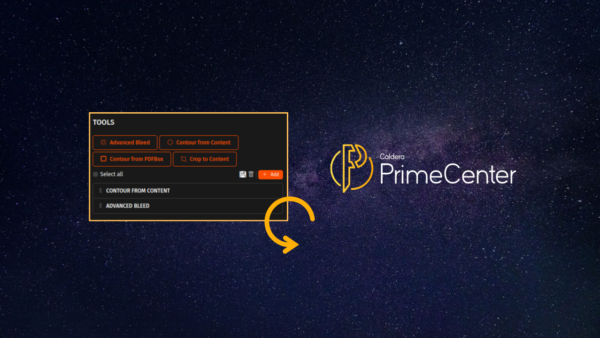
Caldera PrimeRIP addresses this challenge by bringing automated prepress into the production workflow through PrimeCenter. Instead of treating every incoming file as an isolated task, businesses can establish repeatable processes that help prepare jobs according to defined requirements.
PrimeCenter: Where a better production day begins
PrimeCenter is a prepress automation asset in the PrimeRIP workflow. It helps you organize and prepare all your files in a more advanced and organized way. This is made possible by using standardized recipes and settings. Therefore, you will not be obliged to reconfigure things from scratch.
All businesses can create recipes that will be used to prepare tasks, which will help automate the next jobs because you can save the recipe and reuse it in the future. That’s how you will reduce the manual work in your production. If you use a standardized recipe, it will be easier for you to prepare files and save time.
PrimeRIP enables you to prepare jobs up to three times faster. If your business processes numerous files each day, faster preparation can help you reduce the waiting time between incoming orders and production.
Intelligent nesting: Finding more value in every meter of media
Unlike the time you waste, wasted media is visually apparent on the production floor. It always reminds you of the loss. This can happen because of an efficient use of layout that you might be accustomed to or to unused spaces between designs.
By optimizing your layout, you can solve these challenges and save more media. As we have discussed in other articles, PrimeCenter includes advanced true-shape nesting, a tool built to arrange designs according to their forms and give them the best possible layout.
Rather than relying exclusively on rectangular arrangements, true-shape nesting can help fit irregular shapes together more effectively, improving the use of available media.
For print-and-cut applications, where designs often contain complex outlines, this can be useful. Imagine several designs being prepared for production on the same roll of media. Their dimensions, quantities, and contours determine how efficiently they can be arranged.
An optimized layout can make better use of that available area, helping reduce unnecessary material consumption while preparing jobs for production. The potential benefits extend beyond the immediate savings on a single roll.
- More efficient material utilization: Better arrangements can help fit more designs into the available production area
- Lower material consumption: Reduced waste can decrease the amount of substrate required for a given volume of work
- Improved cost control: More efficient layouts can help businesses manage one of their recurring production expenses
- A more standardized process: Automated nesting can reduce the need for repeated manual layout adjustments
Caldera PrimeRIP can reduce media waste by up to 20%. The results will vary according to design geometry, media dimensions, job mix, and the efficiency of the existing workflow.
Preparation to production: Why the connection matters
Automating prepress is valuable, but its benefits are limited if prepared files then encounter unnecessary obstacles on the way to production. A modern print workflow needs continuity. The work completed during preparation should support the production stage rather than create another set of disconnected tasks.
CalderaRIP can enormously help in this case. As the professional RIP component of PrimeRIP, CalderaRIP provides the production capabilities that connect prepared artwork with compatible printing and cutting equipment. It supports the processing of print jobs and brings color management and device compatibility into the wider workflow. The combination creates a more coherent and organized production path.
On the other hand, PrimeCenter focuses on getting jobs ready and optimizing their layouts. CalderaRIP takes those prepared jobs into production, helping businesses manage the transition from design preparation to the final result.
More than 2,000 supported devices
Every print business has its own production environment.
Some operate a single wide-format printer. Others manage several printers, cutters, and different types of media. Many have invested in equipment over a number of years and need new software to work with their existing setup rather than require an entirely new one.
Device compatibility is therefore more than a technical specification. It is an important part of determining whether a workflow improvement can work in practice.
Caldera ecosystem supports more than 2,000 printers and cutters, offering a broad range of compatibility options for businesses with different production requirements.

It can also support companies looking to develop their production capabilities over time. As new devices or applications are introduced, a broad device ecosystem provides a foundation for evaluating how the production workflow can evolve.
Automation that gives operators their time back
Automation is often discussed in terms of machines, software, and processing speeds. Yet one of its most important benefits is what it changes for the people working with the technology. Print operators bring experience, technical knowledge, and practical judgment to production. They understand the demands of different jobs, recognize quality issues, and respond to unexpected challenges.
But when too much of their day is consumed by repetitive preparation tasks, there is less time available for those higher-value responsibilities. PrimeRIP is designed to reduce this burden by automating recurring activities and helping standardize the processes that move jobs through production.
The solution highlights the potential to eliminate up to 30% of repetitive tasks. The precise benefit will depend on the business’s existing processes and the tasks that can be automated. For operators, fewer repetitive steps can mean more time to focus on production quality, workflow monitoring, finishing requirements, and the demands of individual customers.
For production managers, standardized processes can make it easier to establish consistent working methods and manage workloads.
For the business as a whole, the benefit is a better use of existing skills and resources. This is an important distinction: automation does not have to mean removing the human element from production. It can mean removing unnecessary repetition so people can concentrate on the work where their knowledge makes the greatest difference.
Integrating efficiency into the production environment you already have
Introducing new software can feel like a major decision, especially for businesses with established production processes.
Equipment represents a substantial investment. Operators are familiar with existing workflows. Customers still expect orders to be delivered on time while changes are being introduced. For that reason, workflow improvements need to be practical as well as technically capable.
PrimeCenter is compatible with PDF-enabled RIP workflows, while CalderaRIP supports a broad ecosystem of printers and cutters. This offers businesses a basis for evaluating how PrimeRIP can fit into their existing production environment. The exact setup will depend on the equipment, software, and requirements involved, so checking compatibility is an important part of the implementation process.
PrimeRIP also follows a subscription-based model, providing an alternative to traditional perpetual-license purchasing arrangements. Businesses should assess the available subscription, included functionality, support, and overall cost to determine the best fit for their operation.
Caldera PrimeRIP: Make every part of production count
The printing industry is built on precision, deadlines, material costs, and customer expectations. Meeting those demands takes more than a capable printer. It takes a workflow that supports the entire production process. Caldera PrimeRIP brings that broader perspective into focus by connecting automated prepress, intelligent nesting, and professional RIP software in one production approach.
With PrimeCenter, repetitive preparation tasks can become more manageable and layouts more efficient. With CalderaRIP, prepared jobs can move into production through a broad ecosystem of compatible devices, supported by professional color management.
The potential advantages extend across the business: faster preparation, improved media utilization, less repetitive work, more consistent processes, and greater opportunities to increase production capacity.
The real benefit is the ability to make better use of the resources already at your disposal while building a workflow that can adapt as your business evolves. Less time lost before the print. Less material wasted during production. More potential in every working day.
Caldera PrimeRIP is about looking beyond the printer to the entire process that makes successful printing possible. And when that process works smarter, the whole business has more room to move forward.
Related articles